
Hospital Patient Monitoring System
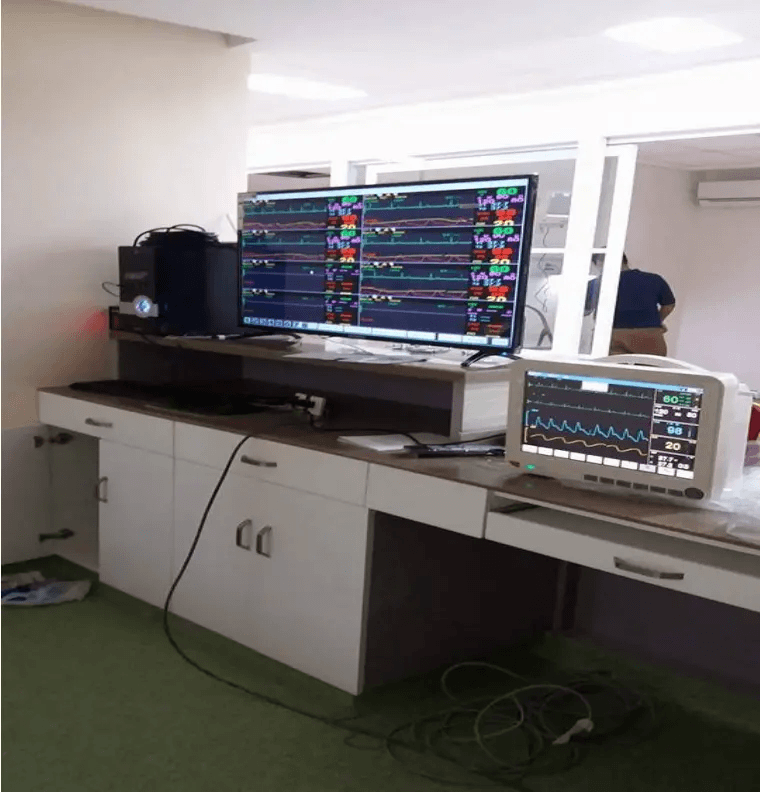
hospital central patient monitoring system
This system collects real-time physiological data including ECG waveforms, heart rate, oxygen saturation, blood pressure and respiratory parameters. The monitoring data can be displayed locally on bedside monitors and centrally at the nurse station for efficient patient management.
System Architecture of Hospital Patient Monitoring
A hospital patient monitoring system typically consists of three key components:
Bedside Patient Monitors
Installed near patient beds to collect physiological signals such as ECG, SpO2 and blood pressure.
Central Monitoring Station
Located at nurse stations or monitoring centers to display patient data from multiple bedside monitors.
Network Data Communication
The monitoring system connects bedside monitors and central stations through wired or wireless networks, enabling real-time data transmission and centralized monitoring.
Key Monitoring Parameters
Hospital monitoring systems continuously track multiple physiological parameters, including:
• ECG waveform monitoring
• Heart rate monitoring
• Oxygen saturation monitoring (SpO2)
• Non-invasive blood pressure monitoring (NIBP)
• Respiratory monitoring
• Body temperature monitoring
These parameters help medical professionals quickly evaluate patient conditions and detect early signs of deterioration.
Recommended Patient Monitors for Hospital Monitoring Systems
Suitable patient monitors for hospital monitoring deployment include:
Clinical Applications
Hospital patient monitoring systems can be deployed across multiple departments.
ICU Monitoring→
Continuous monitoring for critically ill patients.
Emergency Monitoring→
Rapid monitoring during emergency treatment.
General Ward Monitoring→
Routine bedside monitoring for hospitalized patients.
Operating Room Monitoring→
Vital signs monitoring during surgical procedures.
Benefits of Centralized Patient Monitoring
A centralized hospital monitoring system provides several operational advantages:
• Real-time monitoring of multiple patients
• Faster clinical response to abnormal vital signs
• Improved workflow efficiency for medical staff
• Better patient safety through continuous observation
By integrating monitoring devices and central stations, hospitals can improve patient care quality and monitoring efficiency.